

OVERVIEW
About this Project
FST/2023/153 is a five-year research and development project funded by the Australian Centre for International Agricultural Research (ACIAR) and commissioned to Griffith University. It brings together researchers, government agencies, and industry partners from Laos and Australia to expand sustainable, profitable, and inclusive wood processing based on plantation resources generating economic, environmental, and social benefits along the entire supply chain.
Development context
Laos remains a Least Developed Country (LDC) with nearly a quarter of its population below the poverty line. Seventy percent of the Lao population works in agriculture, and lifting household incomes in this sector is critical to the country's future. At the same time, Laos has experienced substantial deforestation and significant economic challenges since 2021 including currency depreciation, high inflation, and constrained access to skilled labour.
The Government of Laos has identified plantation forestry and associated wood processing as key opportunities to alleviate poverty, improve livelihoods, increase tree cover, and meet climate change objectives. Yet Laos is still missing out on value-adding market opportunities in plantation-derived forest products particularly rubberwood, acacia, and eucalypts that neighbouring countries like Vietnam and Thailand have seized.
Global demand for wood products is projected to quadruple over the next 30 years. Given Laos's high plantation productivity, declining native forest fibre globally, and proximity to major markets, the country is well-positioned to expand its forestry and forest products manufacturing sectors. This project provides the research, policy, and technical support to make that expansion sustainable and inclusive.
Why rubberwood matters
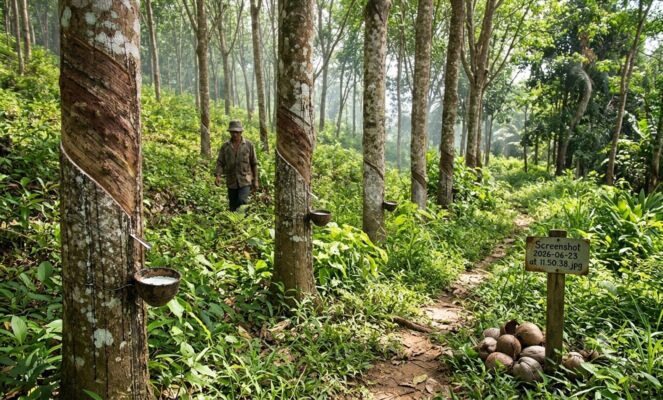
Rubber plantations represent approximately 58% of Lao plantation area around 300,000 hectares and the majority are expected to become senescent by 2030. Currently, this timber is often wasted or burned as low-grade fuel. This project works to convert senescent rubberwood into high-value engineered wood products (EWPs) for domestic and export markets, following evidence from prior ACIAR projects that rubberwood offers a major route to expanded Lao competitiveness and improved returns for smallholders.
Key Partners
Government of Laos (GoL)
• Department of Forestry (DoF) under the Ministry of Agriculture and Environment (MAE)
Leads policy analysis and development activities. Oversees forest resource management, plantation development, and industry regulation.
• Department of Labour Management (DoLM)
Engaged in occupational health and safety reform and regulation for the Lao forest products sector.
Industry associations
• Lao Wood Processors Association
Strategic research and policy needs, MSME support, and promotion of MSMEs in industry structures.
• Lao Furniture Association (LFA)
Collaborates on market development, product quality, and export pathway identification.
• Lao National Chamber of Commerce and Industry
Supports MSME knowledge and skills gap assessment and industry association engagement.
International collaborators
• KfW — Village Forest Management
Collaboration on stakeholder engagement and plantation development.
• GIZ-EU (ProFEB)
Cooperation on Wood Testing Laboratory, forest value chain, circular economy and forest industry waste utilisation.
• World Bank — Lao Landscapes & Livelihoods Project
Coordination on smallholder plantation development and forest livelihoods.
• FAO
Shared learnings on forest governance and sustainable forest industries.
• Luang Prabang Teak Program Plus (LPTP+)
Value chain analysis partner for teak plantation systems in northern Laos.
Private Sectors
• Salwood Asia Pacific Pty., Ltd.
• Burapha Agro-Forestry Co., Ltd.
• PML-easbeam
• Mekong Timber Plantations Co., Ltd
• SilviCarbon
Related ACIAR projects
• FST/2020/137 — Forest Restoration for Economic Outcomes (FREO)
Shared policy workshops, joint gender research, and coordination on forest restoration and livelihoods.
• FST/2019/128 — Coconut and non-traditional forest resources for EWPs
Project Objectives
VALTIP4 (FST/2023/153) aims to expand sustainable, profitable, and inclusive wood processing based on plantation forests in Laos and Australia — increasing household and national incomes while generating social and environmental benefits. The project works across six interconnected areas:
1. Policy & Governance
Strengthening the policy and regulatory environment to support plantation expansion and increase benefits for smallholder farmers and small-to-medium enterprises (MSMEs).
2. Supply Chains & Markets
3. Timber Research & Development
Addressing technical barriers in wood processing, with a focus on rubberwood utilisation and circular economy practices.
4. Capacity Building
Developing the National University of Laos (NUoL) Wood Technology Research Centre (WTRC) into a self-sufficient, internationally recognised research and testing facility.
5. Gender Equity
6. Occupational Health & Safety
Establishing stronger safety standards and practices across Lao forest and wood processing industries.
Research Activities
Project Themes
Theme 1: Policy & Governance
Strengthening enabling environment for plantation expansion and increasing benefits for small holders and MSMEs.
Activities
- Analysis of illustrative plantation value chains — teak, rubber, eucalypt
- Policy analysis and development workshops led by Department of Forestry
- Action research on female livelihoods and household gender dynamics
- Support MSMEs in machining, drying, gluing, preservation, and waste management
Theme 2: NUoL WTRC Capacity
Building critical capacitation of the Wood Technical Research Centre at NUoL toward full self-sufficiency.
Activities
- Enhance WTRC facilities for EWP manufacturing and training
- Establish wood drying experiments and industry services
- SWOT analysis — barriers to WTRC self-sufficiency
- Develop financial and business models for fee-for-service testing and certification
Theme 3: Timber R&D
Addressing technical barriers in wood product recoveries — primary focus on senescent rubber wood plantations and circular economy.
Activities
- Circular economy review and trials — resource recovery, waste reduction
- Resource characterisation of rubber, eucalypt, and teak plantations
- Gluing, durability, and preservation trials
- Bio-based adhesives and bio-friendly wood protection systems
- Demonstration EWP construction building at NUoL
Theme 4: Supply Chains & Markets
Building and understanding and forecasting of global and regional market trends for Lao forest industries.
Activities
- Review EWP and solid wood product types used globally
- Analyse export logistics and regulatory processes
- Market intelligence summary – customs data and commercial reports
Theme 5: Gender and Social Inclusion
Examining gender effects of industry development to improve equity across the supply chain — with focus on ethnic minority women.
Activities
- Action research on female livelihoods — contract farming and wood processing employment
- Study on labour and working conditions of wood harvesting contractors
- Annual gender mainstreaming review across all project activities
Theme 6: Occupational Health & Safety
Establishing routine OH&S Protocols in forest and wood-processing industries in Laos.
Activities
- Comprehensive OH&S review in Lao forest product sector
- Exchange visits with Australian OH&S regulators
- Workshopping findings — OH&S framework and guidelines
- On-site training at selected wood processing companies
SCHEDULE
Project Timeframe
August 2030
Final Reporting & Handover
2028-2029
Full Implementation
2027
Mid-term Evaluation
July 2025
Project Commencement